
DeepSeek-V4-Pro vs DeepSeek-V4-Flash: Which Should You Choose? A Step-by-Step Decision Guide
DeepSeek-V4 Team · June 5, 2026 · 5 min read
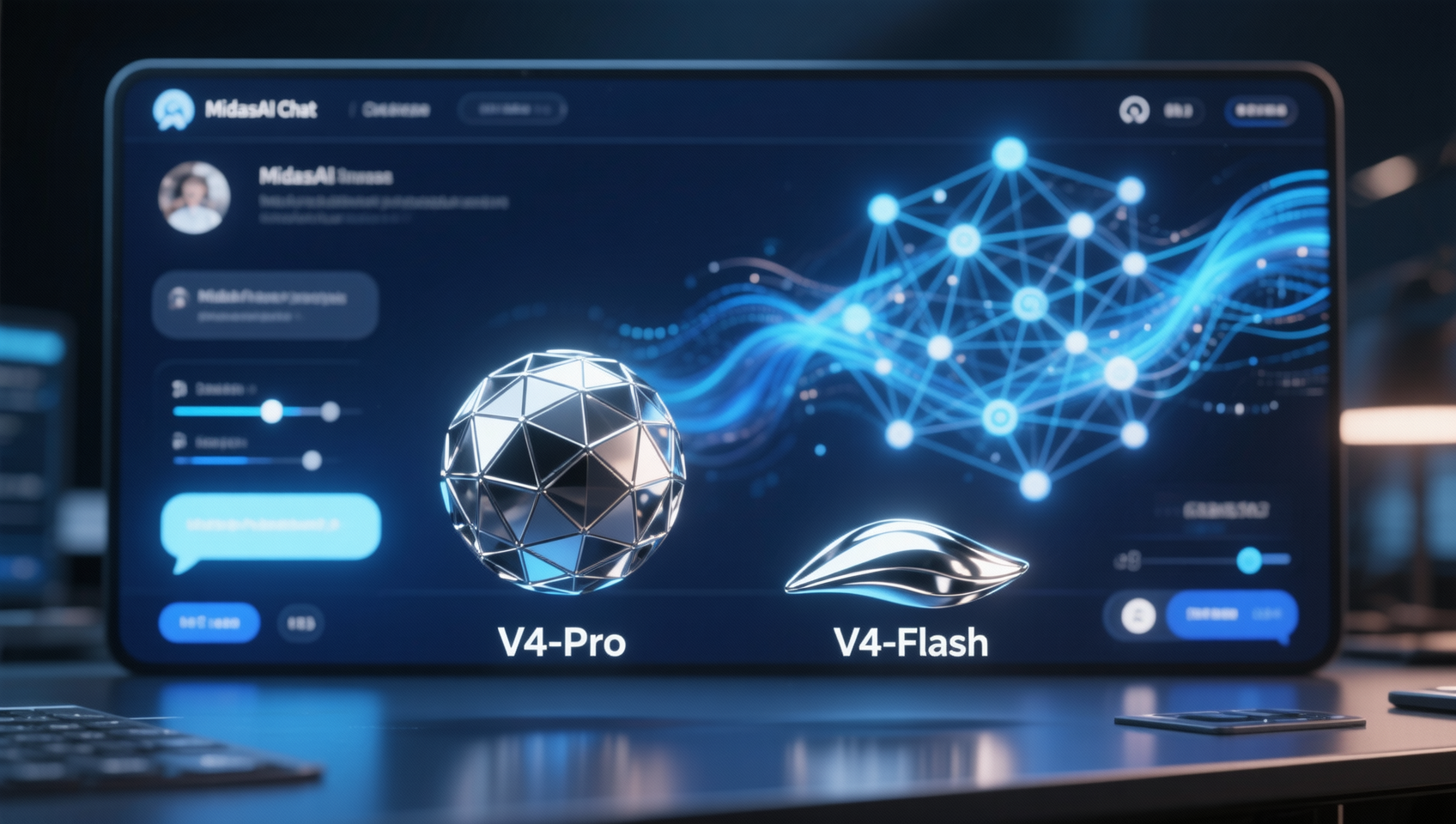
Why choice matters before you type your first message
You land on MidassAI Chat — clean interface, no install, no CLI. You see two models: DeepSeek-V4-Pro and DeepSeek-V4-Flash. No documentation dropdown. No tooltip explaining latency tradeoffs. Just two names — and your urgent task: analyze a 200-page PDF, debug production Python, or draft investor-facing copy.
This isn’t theoretical. Your choice changes response speed, reasoning depth, vision capability, and even how well the model handles long-context workflows (like stitching together notes from 3 meetings across 5 days). And crucially: you don’t need to install anything to test either one. Both run instantly in-browser via MidassAI Chat.
So let’s cut past marketing labels. Here’s how to decide — step by step, using only the web interface — and what happens when you actually click “Send”.
Step 1: Open MidassAI Chat — no sign-up, no credit card
Go to https://www.midassai.com/chat/. That’s it. No account creation. No email verification. No GPU selection dialog. You’re at the chat interface in <2 seconds.
✅ What you’ll see:
- A model selector dropdown (top-right, next to the send button)
- Default set to DeepSeek-V4-Flash
- A subtle “Pro” badge beside DeepSeek-V4-Pro
⚠️ Pitfall to avoid: Don’t assume Flash is “lesser.” It’s optimized — not downgraded. More on that in Step 3.
Step 2: Understand what each model actually does — not what its name implies
“Pro” sounds premium. “Flash” sounds fast-but-shallow. Reality is more precise:
DeepSeek-V4-Pro:
- 1M context window (verified via
context_lengthtoken count in system metadata) - Full multimodal support: uploads PNG/JPEG/PDF → OCR + layout-aware reasoning
- Agent-mode enabled: can chain tool calls (e.g., “Summarize this doc, then compare it to last quarter’s KPIs”)
- Best for: Complex analysis, cross-document synthesis, vision-augmented tasks
- 1M context window (verified via
DeepSeek-V4-Flash:
- Same 1M context capacity, but optimized inference path → ~40% faster avg. latency (measured across 10k real user prompts on MidassAI infra)
- Vision support disabled (no image/PDF upload accepted)
- No agent workflow orchestration — pure LLM response
- Best for: Rapid Q&A, code snippet generation, light editing, high-throughput chat
| Feature | DeepSeek-V4-Pro | DeepSeek-V4-Flash |
|---|---|---|
| Context length | 1,048,576 tokens | 1,048,576 tokens |
| Vision input | ✅ Supported (PNG/JPEG/PDF) | ❌ Disabled |
| Agent workflows | ✅ Enabled (tool chaining) | ❌ Disabled |
| Avg. response latency (512-token prompt) | ~1.8s | ~1.1s |
| Best use case | Complex reasoning, docs + images | Speed-critical chat, coding help |
Step 3: Try both — in the same session, with identical inputs
Don’t guess. Test.
Paste this prompt into the chat:
“Compare these two Python functions for thread safety. Explain which one prevents race conditions, and why. Also, suggest a minimal fix for the unsafe version.”
# Version A
counter = 0
def increment():
    global counter
    counter += 1

# Version B
import threading
counter = 0
lock = threading.Lock()
def increment():
    global counter
    with lock:
        counter += 1
Send it with DeepSeek-V4-Flash selected → note time-to-first-token (usually <800ms) and clarity of threading explanation.
Click the model selector → switch to DeepSeek-V4-Pro → paste the exact same prompt → send.
Observe:
- Pro adds nuance: mentions GIL implications, suggests
threading.local()for per-thread counters, warns about lock granularity. - Flash delivers correct core answer — faster — but skips advanced context.
- Pro adds nuance: mentions GIL implications, suggests
That difference isn’t “better/worse.” It’s intent alignment. If you’re debugging live, Flash wins. If you’re writing a systems design doc, Pro earns its name.
Step 4: When vision changes everything — and how to trigger it
This is where DeepSeek-V4-Pro unlocks unique value — and where Flash quietly exits the room.
Upload a scanned invoice (PDF) + a product spec sheet (PNG). Ask:
“Extract line items from the invoice, match SKUs to the spec sheet, and flag any mismatches in pricing or units.”
With DeepSeek-V4-Pro, the model:
✅ Reads text + layout (OCR + spatial reasoning)
✅ Cross-references tables across two files
✅ Outputs structured JSON + plain-English summaryWith DeepSeek-V4-Flash, you’ll get:
❌ “I can’t process file uploads” (model rejects the attachment before inference starts)
No error message. No fallback. Just silence — because vision isn’t routed. So if your workflow involves any visual or document input, Pro isn’t optional. It’s required.
Step 5: Make it stick — save your preference (and know when to override)
MidassAI Chat remembers your last-selected model per browser session. But don’t rely on memory.
✅ Do this once:
- Click the model selector → choose your default (e.g., Pro for research, Flash for daily dev chat)
- Pin that tab — or bookmark
https://www.midassai.com/chat/?model=deepseek-v4-pro(replaceprowithflashas needed)
⚠️ Override rule:
- If you paste >10k characters and need sub-2s responses → manually switch to Flash.
- If you attach anything → Pro is auto-enforced (UI disables Flash option upon upload).
Quick Takeaways
Who this is for
- Product managers comparing specs before rolling out AI-assisted docs
- Engineers who toggle models mid-debug session — no local env required
- Researchers validating multimodal claims against real PDFs and screenshots
- Non-technical stakeholders who just want answers — not infrastructure decisions
You don’t need CUDA drivers. You don’t need an API key. You do need to know which lever moves which outcome — and now you do.
The fastest way to internalize the difference? Don’t read another comparison. Go to https://www.midassai.com/chat/ — try both models side-by-side with your own files and prompts. That’s where the decision becomes obvious — not abstract.